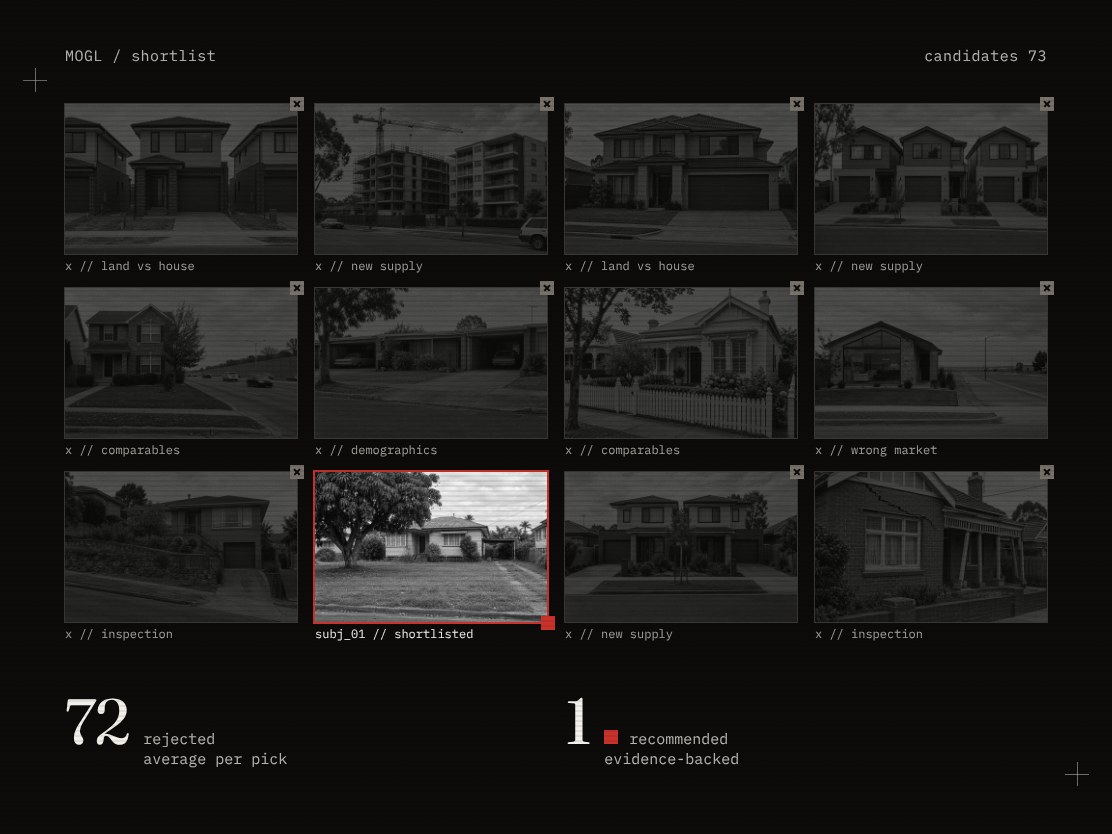
I miss more houses than I buy. That’s not a confession; it’s the whole point of hiring someone to do this.
Somewhere along the line, “buyers’ agent” came to mean “person who finds you a property”. Anyone can find you a property. There are a couple of hundred thousand of them for sale on any given day.
The job is saying no. Across the purchases we track, we reject an average of 72 properties for every one we put in front of a client. Some of those are a two-second no from the listing. Some get a full workup, an inspection and a phone call to the agent before they get crossed off. Either way, the discipline is the same: a property has to earn its place, and most don’t.
So what actually gets a property rejected? Let me go round the grounds.
1. It’s in the wrong market
Most rejections happen before we’ve looked at a single house, because the suburb didn’t make the shortlist. Our suburb selection scores markets across the whole country on the things that actually move prices: supply coming online, demand from people in their working years, rental performance, and the risks that could stall it for a decade. Then a human who has bought through multiple cycles checks what the data can’t see.
No favourites, and no postcodes we’re paid to push. If a suburb doesn’t score, it doesn’t matter how nice the listing photos are.
2. New supply next door
This is the fastest no on the list. Open the map, look for cleared land, display villages, “final stage now selling”. New housing is new supply, and new supply pushes down demand for everything around it, sometimes for years.
The industry has a lovely phrase for these areas: “growth corridor”. What grows in a growth corridor is the number of houses, not the price of yours. We walk away.
3. Too much house, not enough land
We look at the land-to-asset ratio on every property: roughly what share of the price is dirt versus building. As I’ve written before, land appreciates and buildings depreciate, so we want the majority of your money in the land. A shiny renovation on a small block usually fails this test; a dated house on a big, flat, rectangular block usually passes it. Ugly is fine. Ugly is often the point.
4. The demographics are a pine cone
Pull up the population chart of an area and you want to see the bulk of people in their working lives. Work means income, income means demand for housing, demand means prices go up. When the chart looks like an upside-down Christmas tree, lots of retirees and not many young families coming through, we get reluctant, even if the yield looks fine today.
5. The price doesn’t survive the comparables
Before we bid, we appraise. Here are the last three months of sales for houses on similar land in the same pocket; here’s the range I expect; here’s the buffer on top in case I’m wrong. If the vendor’s expectation sits above that and won’t come down, we don’t chase it. We make our profit when we purchase. Overpay and you don’t lose money so much as you lose time, and time is the one thing a six-year hold can’t give back.
The rule is simple: if we can’t get a good deal, we walk. There will be another good deal next week. There always is.
6. Something the inspection found
Building and pest, flood and bushfire overlays, easements, illegal extensions, a body corporate with an empty sinking fund. Some of these are a negotiation; some are a hard no. What we won’t do is talk you past them because we’re three months into a search and everyone’s tired.
The one that made a client cry
A few years back I bought a house in Brisbane for a client. Dated, scuffed up, not lovingly cared for. She saw it for the first time after we’d secured it and burst into tears, and not the good kind. I paid $400 out of my own pocket for the broken cooktop just to make her feel a bit better about it.
That property has since roughly tripled in value. It’s one of the strongest performers in our whole track record, and it got there for exactly the reasons it was ugly: big block, old house, right market, bought below the comparables. The 72 we rejected before it were mostly prettier.
What to take from this
If you’re searching on your own, you don’t need our whole method to get better at this. Just get better at no. Before you fall for a listing, check the three fastest filters: is there new estate land nearby, how much of the price is land, and what does the age profile of the suburb look like. Those alone will knock out most of the 72.
And if you’d rather have someone do the rejecting for you, and put their own money on the outcome, that’s what our full service and the $5,000 performance guarantee are for. Every purchase we can currently value is on the results map. Have a look at the ones that weren’t pretty.
Jake Milne
CEO & Lead Buyers Agent, MOGL
mogl.com.au
This article is general in nature and does not constitute licensed financial, tax or credit advice. The 72-to-1 figure is an average across our tracked purchases and varies by brief and market. Past performance is not a reliable indicator of future results.